
Uncategorized
10 High Domain Authority Sites for Backlinks in 2026
Sep
You already know that one backlink from a real DA 60+ site does more for your rankings than fifty links from spammy directories. The problem is finding high domain authority sites for backlinks that actually accept guest posts, niche edits, or citations without charging a fortune or burying your link in a PBN nobody trusts.
This article gives you exactly that: a working list of high domain authority websites for backlinks you can pursue in 2026, along with what each site expects from contributors and how to approach outreach without getting ignored. If you have ever wondered why your DA 40 backlinks aren’t moving the needle, the answer usually comes down to picking the wrong targets, not the wrong tactics.
We built this list for bloggers and site owners who need results, not theory. You will get ten vetted platforms, realistic acquisition strategies, and tips on avoiding link schemes that tank your rankings instead of boosting them. If you are already using our SEO service packages to build authority faster, treat this as the roadmap for where those efforts should be pointed.
1. Technotareen high-DA backlink services
Start with the option you control directly: Technotareen’s high-DA backlink service. We built this because most bloggers in Pakistan and beyond don’t have the relationships or time to pitch fifty editors a month, and buying random Fiverr gigs usually lands you on a spam network that Google eventually deindexes. Instead, you get placements on vetted, indexed sites with real organic traffic, sold as clear packages instead of vague promises.
A backlink only helps you if the site hosting it still ranks next year.
Domain authority
Our packages target sites in the DA 40 high quality backlinks service and DA 50+ range, checked with Moz and Ahrefs before any placement goes live. We don’t count PBNs or link farms toward that number. Every domain gets manually reviewed for organic traffic, spam score, and topical relevance to your niche before it makes the list, so the high domain authority backlinks you buy actually match what the metrics claim.
Backlink type
You get contextual, do-follow links placed inside relevant published content, not footer links or sitewide spam. Depending on the package, that means a guest post built around your target keyword, a niche edit inserted into an existing ranking article, or a mention on one of our pre-vetted blogger network sites. Each link comes with a placement report showing the URL, anchor text, and DA/DR at time of publishing.
How to get a backlink
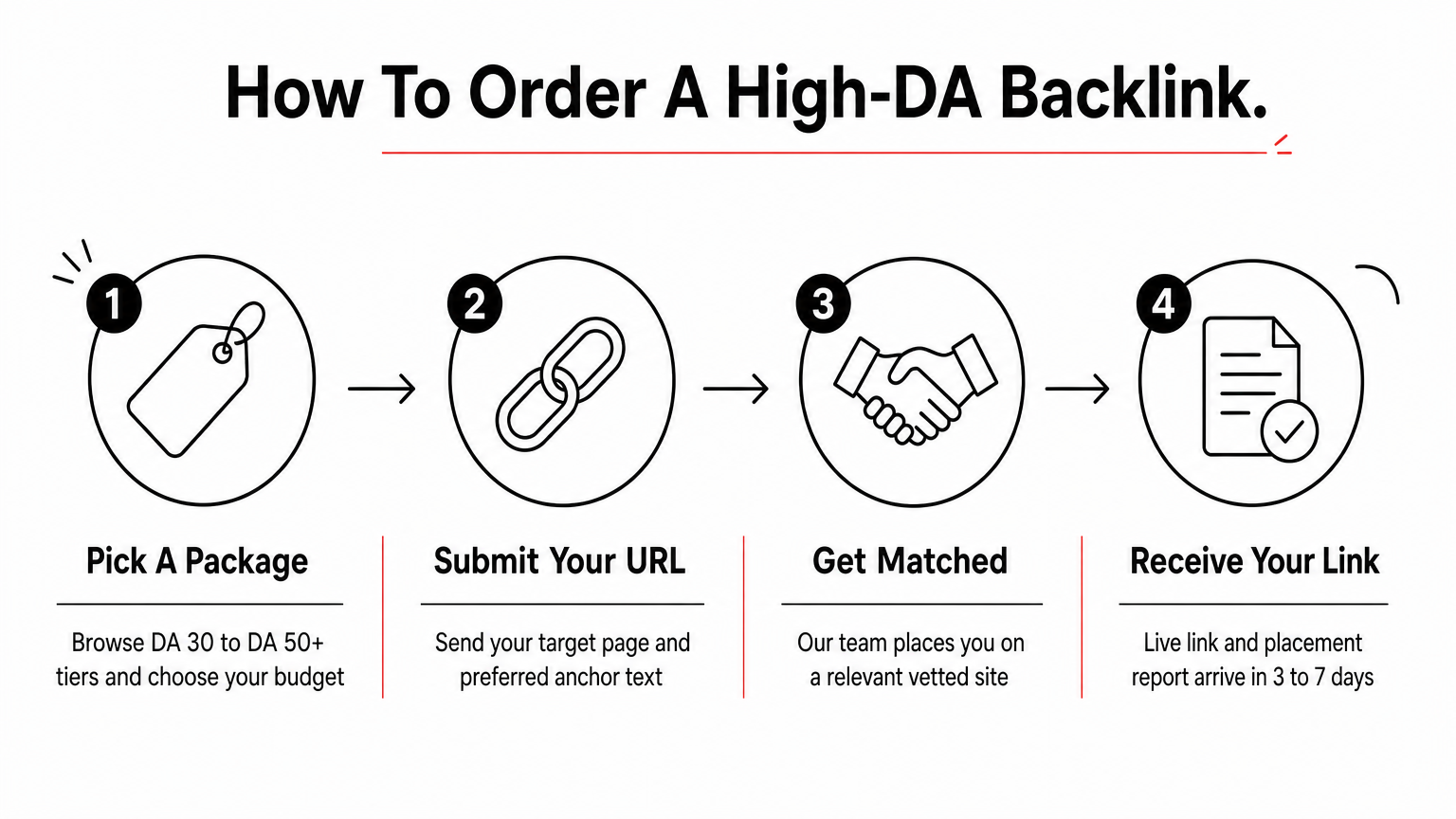
Ordering is straightforward:
- Browse the DA 50 service packages and pick a DA tier that fits your budget.
- Submit your target URL and preferred anchor text.
- Our team matches you with a relevant site from the vetted list.
- You receive the live link and placement report within the stated turnaround, usually 3 to 7 days.
Cost
Pricing is quoted in both PKR and USD so international buyers know exactly what they’re paying without guessing at conversion rates.
| Package | DA Range | Typical Use |
|---|---|---|
| Starter | DA 30-40 | New blogs building initial authority |
| Growth | DA 40-50 | Sites ready to push rankings faster |
| Premium | DA 50+ | Competitive niches needing strong signals |
Compared to freelance outreach, which can eat weeks of unpaid time, you can simply get DA 50 for your website without the chasing.
2. Connectively and Qwoted for media backlinks
Journalists need sources, and platforms like Connectively (formerly HARO) and Qwoted connect you with reporters looking for quotes. You sign up, browse daily queries in your niche, pitch a short answer, and if a journalist picks you, you land a mention with a backlink in a real news or industry publication. This is one of the few white-hat routes to placements on sites you could never guest post on directly, since outlets like Forbes or Business Insider don’t accept pitches from random bloggers.
Domain authority
The domain authority here isn’t fixed to one site. It depends entirely on which publication picks up your quote, and that can range from a mid-tier trade blog at DA 40 to a major outlet at DA 80+. You don’t control the outcome, but the ceiling is higher than almost any other tactic on this list.
One good HARO-style pitch can land you a link no amount of paid outreach could buy.
Backlink type
Most placements are contextual, do-follow citation links embedded in an article, crediting you as a quoted expert.
How to get a backlink
- Create a profile on Connectively or Qwoted with your niche expertise listed clearly.
- Check queries daily and pitch within the first few hours; late responses rarely get picked.
- Keep pitches under 150 words with a direct quote a journalist can copy-paste.
Cost
Connectively offers a free tier with limited queries; paid plans start around $19 to $149 monthly for more visibility and faster access.
3. Software review platforms like G2 and Capterra
If you sell any kind of software, tool, or SaaS product, G2 and Capterra give you a straightforward path to a backlink without pitching a single editor. You claim your product profile, fill in the details, and once verified reviewers start leaving feedback, your profile page goes live with a link back to your site. Software review platforms like these carry weight with Google because they’re built entirely around user-generated, third-party validation, which is exactly the kind of trust signal link schemes can’t fake.

Domain authority
Both platforms sit comfortably above DA 80, with Capterra often scoring even higher thanks to its Gartner ownership. That puts them well above most guest post targets on this list, making them genuinely high domain authority sites for backlinks if your product qualifies for a listing.
A single verified G2 profile link often outweighs a dozen guest posts on smaller blogs.
Backlink type
Expect a do-follow profile link plus, in some cases, additional links from comparison pages and category roundups once your review count grows.
How to get a backlink
Claiming your listing takes a few steps:
- Create a vendor account and verify ownership of your product.
- Fill out your profile completely, including screenshots and pricing.
- Ask satisfied customers to leave reviews, since profiles with more reviews rank higher on-site and get indexed faster.
Cost
Basic listings are free. Paid tiers, which unlock analytics and premium placement, typically run from $200 to $2,000 monthly depending on the plan and platform.
4. Business directories like Clutch and GoodFirms
If you run an agency, consultancy, or B2B service, Clutch and GoodFirms give you a listing that doubles as a lead source and a solid backlink. Businesses use these directories to vet vendors before hiring, so getting listed puts you in front of buyers actively searching for what you do, not just search engines. Unlike a random guest post, this is a backlink type tied to genuine business verification, which is why Google treats these directories as trustworthy rather than manipulative.
Domain authority
Clutch sits around DA 88 and GoodFirms around DA 70, both well within the range of high domain authority websites for backlinks that most bloggers never manage to reach through outreach alone. That authority comes from years of indexed reviews and case studies, not paid placement tricks.
A verified directory listing earns trust that a guest post can only imply.
Backlink type
You get a do-follow profile link, and active profiles often earn secondary links when Clutch features you in category rankings or "top agencies" roundups.
How to get a backlink
- Create a business profile with your services, portfolio, and location.
- Request reviews from past clients through the platform’s verification process.
- Keep your profile updated, since inactive listings get buried below competitors.
Cost
Basic listings are free on both platforms. Clutch’s premium visibility packages start around $3,000 annually, while GoodFirms offers cheaper paid tiers closer to $50 to $200 monthly for badges and featured placement.
5. Crunchbase for startup and company profiles
Crunchbase works differently from a guest post pitch. You claim or create a company profile, fill in funding history, team details, and a link back to your site, and the profile goes live as a permanent record investors, journalists, and other founders actually reference. This makes it one of the more overlooked high domain authority backlinks sites for startups, since most founders think of Crunchbase as a research tool rather than a link-building opportunity.
Domain authority
Crunchbase runs around DA 90, putting it near the top of every list of high domain authority websites for backlinks you’ll find anywhere. That authority comes from a decade of aggregated funding data and press coverage, not paid placements.
A Crunchbase profile keeps earning citations from journalists long after you stop actively promoting it.
Backlink type
You get a do-follow profile link, and profiles with funding announcements or acquisitions often get cited (with a link) by tech news outlets covering the story, which compounds your visibility beyond the initial listing.
How to get a backlink
- Search Crunchbase to see if your company already has an unclaimed profile.
- Claim it or create a new one with accurate funding, team, and location details.
- Add your website URL and keep the profile updated after every funding round or major hire.
Cost
Basic profile claims and edits are free. Crunchbase Pro, aimed at investors and researchers rather than link builders, starts around $49 monthly, but you don’t need it to get your backlink live.
6. LinkedIn articles and newsletters
LinkedIn doubles as a publishing platform, and most bloggers ignore it because they think of it purely as a networking site. Publish a long-form article or start a newsletter on your profile, and every piece gets indexed with a link back to whatever you mention inside it, including your own site. This is one of the few high domain authority backlinks sites where you control the content completely, no editor approval, no pitch rejection, just your own account and audience.

Domain authority
LinkedIn itself sits around DA 98, one of the highest scores on this entire list. Individual articles and newsletter editions inherit that authority instantly since they’re hosted on linkedin.com rather than a subdomain, which is rare among high domain authority sites for backlinks.
Publishing on LinkedIn gets you a DA 98 backlink without waiting on anyone’s approval.
Backlink type
Links inside LinkedIn articles are do-follow, though LinkedIn occasionally adjusts this policy, so check current link attribution before relying on it for a critical campaign.
How to get a backlink
- Publish an article through LinkedIn’s native publishing tool, not just a status update.
- Link to a relevant page on your site within the body text, ideally with context rather than a bare URL.
- Start a newsletter to build repeat readers who click through on every edition.
- Cross-post your best blog content natively, adapting the intro for LinkedIn’s audience.
Cost
Publishing articles and newsletters is completely free. LinkedIn Premium, which helps with visibility and analytics, runs about $29.99 to $59.99 monthly, but it has no bearing on whether your link gets indexed.
7. Web 2.0 platforms like WordPress and Tumblr
Web 2.0 sites let you publish content on someone else’s high-authority domain, using free blogging platforms like WordPress.com, Blogger, and Tumblr. You create a free subdomain, write a full article around your target keyword, and link back to your main site from within the post. This tactic gets a bad reputation because spammers abused it for years, stacking thin content across hundreds of Web 2.0 blogs to manipulate rankings, but a handful of well-written, genuinely useful posts on high domain authority sites for backlinks like these still works fine.
Domain authority
WordPress.com sits around DA 94 and Tumblr around DA 90, both far above what you’d ever build on a standalone blog in year one. Your individual post inherits some of that root domain authority, though nowhere near the full number, since Google evaluates the specific page and its content quality too.
A thin Web 2.0 post won’t borrow much authority no matter how high the root domain scores.
Backlink type
Expect a do-follow contextual link inside a full article, not a comment or profile link, as long as the platform hasn’t restricted link attribution on free accounts.
How to get a backlink
- Create a free account on WordPress.com, Blogger, or Tumblr.
- Write a genuinely useful 600+ word article, not a spun rewrite, using the same standards you’d apply to writing content for your blog.
- Link naturally to a relevant page on your main site.
- Publish on a schedule instead of dumping ten posts at once.
Cost
Free accounts cover everything you need. Paid plans, starting around $4 to $25 monthly, only add custom domains and remove ads, neither of which affects your backlink.
8. Guest posting on niche blogs
Guest posting means writing a full article for someone else’s blog in exchange for a byline and a link back to your site. Unlike Web 2.0 posts, you don’t control the domain, so you need to pitch editors who already run a blog with real traffic in your niche. This remains one of the most reliable ways to land backlinks with high domain authority because a good pitch gets you placed next to content the site owner already vouches for.
Domain authority
Quality varies wildly here, from DA 25 hobby blogs to DA 60+ industry publications with genuine audiences. Target sites above DA 40 with real comment activity and recent posting history, since a blog that hasn’t published in eight months won’t pass Google’s freshness signals no matter what its DA score claims.
Pitch the blog you’d actually read, not just the one with the highest score.
Backlink type
Most guest posts carry a do-follow contextual link inside the body, though some sites now default author bio links to no-follow, so confirm this before you write.
How to get a backlink
- Search "[your niche] + write for us" to find open submission blogs.
- Read three recent posts before pitching so your topic fits their style.
- Offer two or three specific headline ideas instead of a vague "can I contribute" email.
Cost
Many niche blogs accept posts free in exchange for content. Paid placements typically run $50 to $300 depending on the site’s traffic and DA.
9. Resource pages and link roundups
Resource pages exist purely to link out to useful tools, guides, or articles on a given topic, which makes them one of the easiest high domain authority backlinks targets once you know they exist. Link roundups work the same way but run weekly or monthly, curating the best content published recently in a niche. Both formats already prove the site owner wants to link out, so you’re not fighting the usual guest post gatekeeping.
A resource page owner already wants to link out, you just need to give them a reason to pick you.
Domain authority
Quality swings widely, from DA 20 hobby blogs curating a short list to DA 60+ university and industry sites maintaining long-standing resource libraries. University .edu resource pages, in particular, often carry authority far beyond what their traffic would suggest.
Backlink type
Expect a do-follow link listed alongside a short description, usually one line, sometimes with your site’s name as anchor text rather than a full sentence.
How to get a backlink
- Search "[your niche] + resources" or "[your niche] + link roundup" to find active pages.
- Confirm the page updated within the last year before pitching.
- Send a short email naming the exact resource you want added and why it helps their readers.
- Follow up once after a week if you hear nothing.
Cost
This tactic costs nothing beyond your outreach time, making it one of the cheapest ways to land high domain authority websites for backlinks on this entire list.
10. Podcast guesting through MatchMaker.fm
Podcast guesting gets you a backlink most bloggers never think to chase, and MatchMaker.fm makes the matching process painless. You build a guest profile listing your expertise, browse podcasts actively looking for guests, and pitch directly through the platform instead of cold-emailing hosts who ignore strangers. Once you land a spot, most hosts publish show notes with a link back to your site, which makes this one of the more overlooked ways to collect high domain authority backlinks without writing a single article yourself.
Domain authority
The show notes page usually lives on the podcast’s own website, so authority varies from DA 20 indie shows to DA 60+ podcasts with a dedicated media presence. MatchMaker.fm itself sits around DA 40, though that’s irrelevant since your link lives on the host’s site, not the matching platform.
The podcast conversation matters less for SEO than the show notes link it generates afterward.
Backlink type
Expect a do-follow contextual link inside the episode’s show notes, often alongside a short bio and sometimes a second link if the host also publishes a transcript.
How to get a backlink
- Build a MatchMaker.fm profile with a clear pitch angle, not just a job title.
- Filter shows by niche and recent episode activity before pitching.
- Ask directly whether show notes include a link back to guests.
Cost
MatchMaker.fm offers a free tier with limited monthly matches; paid plans run roughly $15 to $79 monthly for unlimited pitching and priority visibility.
Building backlinks that actually help your SEO
Ten sources, one filter that matters: does the site have real traffic and a real editorial standard, or is it just a number on a metrics tool? High domain authority sites for backlinks only move your rankings when the placement sits on a page Google actually trusts, not a recycled directory nobody visits. Mix tactics instead of leaning on one. Pitch journalists through Connectively, claim your Crunchbase and G2 profiles, publish on LinkedIn, and pick off a few resource pages while you’re at it.
Speed matters too. Outreach alone can take months before you land placements worth bragging about, and most bloggers don’t have that runway. If you’d rather skip the pitching and get high domain authority backlinks live within days on vetted, indexed sites, browse our backlink packages for sale and pick the DA tier that matches where your site stands today.
